
Preparing for GCSE Without the Pressure:
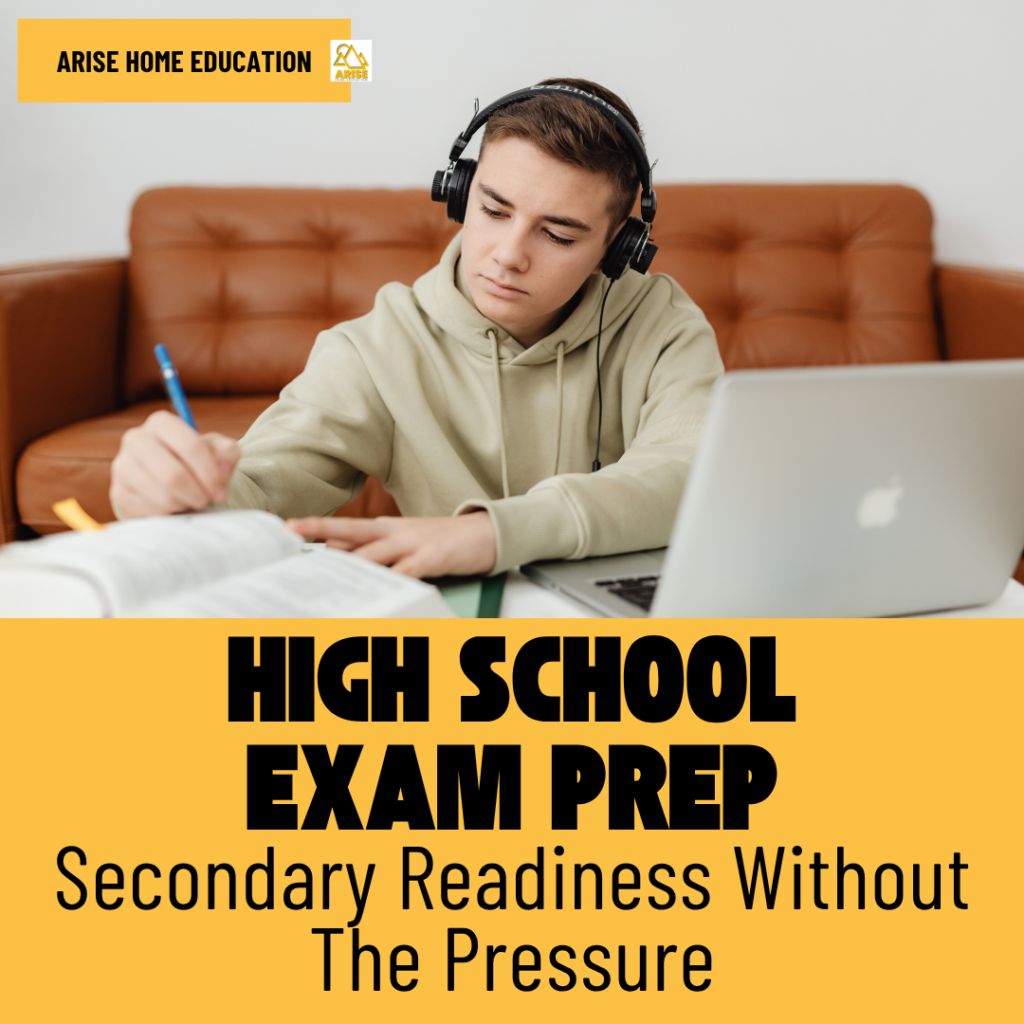
A Christian Home Education Guide to Secondary Readiness for Ages 14–16
Academic readiness isn’t about preparing for GCSE and IGCSEs as quickly as possible. It’s about preparing young people to flourish with wisdom, confidence and Christ-centred purpose.
One of the greatest freedoms of home education is that we don’t have to follow the timetable of the school system. Yet many home educating parents begin to feel anxious when their children reach 14 or 15.
- “Should we be starting GCSEs now?”
- “Everyone else seems to be taking exams.”
- “What if my teenager isn’t ready?”
These questions are completely understandable. The teenage years often bring a shift in expectations as students begin preparing for qualifications, future careers, apprenticeships, university or vocational training. But there is another question that deserves our attention first:
What does genuine readiness for upper secondary education actually look like?
The answer may surprise you.
Readiness Is About More Than Exams
When people talk about preparing for GCSE or IGCSEs, they often focus on curriculum.
- Which syllabus?
- Which exam board?
- How many subjects?
While those decisions matter, Emma and Shannan from Arise Home Education, repeatedly reminds parents that academic readiness begins much earlier than exam specifications.
A student who is ready for upper secondary study is developing:
- confidence
- resilience
- independent learning
- perseverance
- organisation
- mathematical reasoning
- clear written communication
These qualities support success far beyond examination season. They prepare young people for adult life as faithful disciples who are equipped to think clearly, communicate wisely and steward responsibility well.
GCSEs Are Designed for Sixteen-Year-Olds
This simple reminder is incredibly freeing. Sometimes home educating families feel pressure to start preparing for GCSE courses early because they have the flexibility to do so. Equally, parents of struggling learners often worry that their teenager is “behind” if they aren’t ready at fourteen. Neither assumption is necessarily true.
The presenters encourage families to remember that GCSEs and IGCSEs were originally designed for students around the age of sixteen. Home educators are uniquely positioned to work backwards from that goal rather than feeling constrained by school timetables.
For some students, beginning exam courses at fifteen instead of fourteen provides an extra year to mature academically and emotionally. That additional time can make an enormous difference.
Strong Foundations Matter More Than Speed
When preparing for GCSE mathematics, it is tempting to move quickly into algebra, equations and higher-level problem solving. However, in the podcast, Emma highlights a different priority. Students should first have secure confidence in:
- fractions
- decimals
- percentages
- ratio and proportion
- basic algebra
- geometry
- mathematical reasoning
These are not glamorous topics. Yet they are the foundation on which almost every GCSE maths question is built. One of the biggest challenges tutors see is not that students cannot understand advanced maths, but that earlier gaps continue to affect later learning. Strengthening foundations is never wasted time.
Mathematical Reasoning Is Different from Arithmetic
Upper secondary maths asks students to think differently. Instead of simply completing calculations, they increasingly need to explain their thinking, apply concepts in unfamiliar situations and solve multi-step problems. Word problems become particularly important. Although many students dislike them, they reveal whether learners can:
- identify relevant information
- choose appropriate methods
- apply mathematical understanding
- explain their reasoning
These are the kinds of skills that build genuine mathematical confidence and important problem solving skills rather than simply memorising procedures.
Independent Learning Becomes Increasingly Important
Perhaps the greatest shift between lower and upper secondary education is independence. Students are expected to:
- organise their work
- plan for completing assignments
- complete longer tasks
- manage deadlines
- review previous learning
- persevere when work becomes difficult
These executive functioning skills often determine whether students thrive during GCSE study.
As parents, our role gradually changes too. Instead of directing every step, we begin coaching, encouraging and asking thoughtful questions. Rather than solving every problem with them, we help them learn how to solve problems themselves. That transition takes time, which is perfectly normal.
Upper & Lower Secondary Maths Classes
-

AS/A Level Maths Year 1
£906.15 -
Functional Skills Maths Level 2
£396.00 -

Higher Maths SQA
£495.00 -
IGCSE Accounting
£396.00 -
iGCSE Maths Sample Lesson
Original price was: £5.00.£0.00Current price is: £0.00. -

iGCSE Maths: Year 1
£396.00 -
iGCSE Maths: Year 2
£396.00 -
KS3 Mathematics
Original price was: £396.00.£198.00Current price is: £198.00. -

Maths and Science Live Lesson Sample Bundle
£0.00
English Readiness Is About Clear Thinking
Many parents think GCSE English is mostly about analysing literature. In reality, clear writing begins with clear thinking. Students preparing for upper secondary study benefit from confidently being able to:
- organise paragraphs logically
- write independently
- follow written instructions
- edit their own work
- recognise grammar patterns
- communicate ideas with increasing clarity
As writing expectations grow, students may be asked to complete assignments ranging from several hundred to well over a thousand words. That can feel overwhelming if they have not gradually developed stamina and confidence beforehand.
Lower & Upper Secondary English Language
-
Writing with Christian Integrity & Academic Accuracy
Original price was: £203.50.£198.00Current price is: £198.00. -

IGCSE English First Language
£396.00 -
British Literature and Composition Sample Lesson
Original price was: £9.00.£0.00Current price is: £0.00. -

Humanities Live Lesson Sample Bundle
£0.00


When Your Teen Isn’t Quite Ready
One of the most encouraging parts of the podcast is its reminder that readiness is not about comparison. If your teenager struggles with:
- algebra
- organising essays
- following complex written instructions
- completing longer assignments
- beginning work independently
it does not mean they have failed. It simply tells you where additional support is needed. Sometimes that support looks like:
- revisiting earlier concepts
- slowing the pace
- working one-to-one
- using a different teaching approach
- allowing another year before beginning exam courses
Home education gives families permission to make these wise decisions.
Watch for Growth, Not Perfection
As Christian parents, we often carry an invisible burden. We want to prepare our children well without letting opportunities slip. Ultimately, we want them to flourish.
Those desires are good. But preparation should never become pressure.
The Emma and Shannan encourage parents to prayerfully identify three things:
- Strengths – What is already secure?
- Gaps – Which foundations need strengthening?
- Next Steps – What is the wisest path forward?
This approach replaces anxiety with intentional planning. Instead of comparing our children with others, we begin recognising how God is uniquely shaping each learner.
Home Education Allows Us to Follow God’s Timing
One of the greatest blessings of Christian home education is freedom. Freedom to
- pause.
- revisit foundations.
- accelerate where appropriate.
- wait when wisdom suggests waiting.
Some students are ready for GCSE study earlier than expected. Others need an additional year to build confidence. Neither path is inherently better.
Our goal is not to produce the youngest student with qualifications. Our goal is to raise mature young adults who love truth, think biblically and are equipped to serve Christ faithfully wherever He leads.
Building More Than Academic Success
The podcast concludes with a beautiful reminder from Proverbs:
“By wisdom a house is built, and through understanding it is established; through knowledge its rooms are filled with rare and beautiful treasures.”
That picture captures Christian home education perfectly. The early years build the foundations. The secondary years strengthen the walls. The later teenage years begin filling that house with knowledge, wisdom, skills and calling.
When we focus first on building strong foundations in maths, English, character and discipleship; we prepare our children for much more than examinations. We prepare them for faithful adulthood. And that is a far greater goal than simply finishing a syllabus.
Courses by Subject
All Arise Home Education Online courses by subject – live and self-paced.
Frequently Asked Questions
Is it okay to delay GCSEs for a home educated student?
Yes. Many home educating families choose to begin GCSE or IGCSE study later if their teenager would benefit from additional maturity, stronger foundations or greater confidence.
How do I know if my child is ready for GCSE maths?
Look beyond age. Students should have secure confidence in fractions, percentages, ratio, algebra, mathematical reasoning and solving unfamiliar problems before beginning GCSE-level work. the Arise Maths Readiness Assessment helps clarify where your student is at with important concepts needed for GCSE level maths.
What is the biggest difference between KS3 and GCSE?
Upper secondary study requires significantly more independence, deeper reasoning, longer writing tasks and stronger executive functioning skills alongside academic knowledge.
What if my teenager struggles with writing?
Rather than rushing into longer essays, strengthen paragraph structure, grammar, organisation and independent writing first. Strong foundations in English grammar and writing make later GCSE writing much more manageable.
What does Christian secondary readiness look like?
Christian secondary readiness combines academic preparation with spiritual formation, growing independence, faithful stewardship of learning and a desire to glorify God through every area of education.
Are Arise Live Classes A Good Fit For Your Teen?
Grab a live lesson bundle and learn about the course, the tutor, and the weekly homework load.














2 thoughts on “Preparing for GCSE Without the Pressure | Secondary Readiness part 2”
Comments are closed.