
Functional Skills Maths for Home Educated Teens Who Struggle with Maths:
A Hope-Filled Alternative
If maths has become the subject that brings tears, arguments or complete shutdown in your home, you’re certainly not alone. Functional skills maths for home educated teens who struggle with maths brings hope for families looking for GCSE qualifications or US high school credit for maths learning.
Many Christian parents choosing a home education lifestyle find that maths is the one subject that feels hardest to adapt. Reading often improves with patience. Writing develops over time. But maths? Sometimes it seems like no matter how much effort everyone puts in, confidence continues to fall.
The encouraging news is this: struggling with maths does not mean your teenager cannot succeed.
In a recent discussion, maths tutor Judy joined Emma to talk about practical ways to support teenagers who find maths genuinely difficult—and why Functional Skills Maths may provide a much-needed stepping stone for many young people.
When Maths Struggles Are More Than Just Disliking the Subject
Every child finds some topics challenging. However, ongoing stress around maths can sometimes point to something deeper. As Judy explains:
“The sign is that children are getting stressed about the subject, it’s not coming easily to them, they’re struggling with some of the abstract concepts as well, those problems that have got several steps to them.”
Maths anxiety is a recognised neurological condition, and children can quickly begin believing they are “bad at maths” even when the difficulties are actually linked to the way they process information. For Christian parents, this is an important reminder that every child is fearfully and wonderfully made. Some simply need a different route to understanding.
Could There Be an Underlying Learning Difference?
Many parents are familiar with dyslexia but have heard much less about dyscalculia. Emma and Judy explain that although dyscalculia certainly exists, it is actually less common than many people assume. Difficulties with maths can also stem from dyslexia, dyspraxia, ADHD or autistic presentations.
Working memory challenges, difficulty recognising patterns, ordering information or remembering mathematical facts can all make maths far harder than it appears on the surface. Rather than rushing to labels, it helps to notice patterns and seek appropriate advice if concerns continue.
Practical Ways to Help a Teen Who Struggles with Maths
One of the greatest strengths of home education is the freedom to slow down. Instead of racing through a curriculum, parents can adapt learning to suit the child in front of them. Some helpful strategies discussed include:
- Keep lessons shorter if concentration fades quickly.
- Use visual resources and manipulatives wherever possible.
- Draw fractions, shapes and number problems instead of relying only on abstract explanations.
- Learn times tables through songs and repetition.
- Break complex problems into smaller steps.
- Stay calm, even when progress feels slow.
- Consider using calculators when the aim is understanding concepts rather than mental arithmetic.
Emma also shared a particularly helpful strategy from teaching her dyslexic son. Rather than expecting him to remember every times table while learning fractions, she allowed him to use a multiplication chart so he could focus on understanding fractions themselves.
Removing one barrier often allows genuine learning to happen.
Why Functional Skills Maths Could Be a Game Changer
One of the most encouraging parts of the conversation was learning more about Functional Skills Maths Level 2. Unlike GCSE Maths, Functional Skills focuses much more heavily on everyday mathematical understanding and practical problem solving. Questions relate to real-life situations such as:
- money management
- measurements
- area and volume
- probability
- planning projects
- workplace calculations
For many teenagers, this feels far more meaningful than highly abstract GCSE Maths topics. As Judy explains:
“It’s a more practical maths qualification, so the questions are going to seem a bit more everyday and a bit more relating to reality… it’s good for a student who’s struggling with those abstract concepts or just can’t see the point.”
For young people considering apprenticeships, practical trades or vocational college courses, these are often exactly the mathematical skills they will continue using.
Is Functional Skills Maths Accepted by Colleges?
This is one of the biggest questions parents ask. The answer is: often yes—but always check first.
Many colleges accept Functional Skills Level 2 as equivalent to a GCSE pass for entry onto certain courses. However, some pathways (particularly more academic or technical qualifications) may still require GCSE Maths.
The advice from Emma and Judy is simple: contact your chosen college or training provider before making long-term decisions. The good news is that Functional Skills doesn’t close doors. In fact, it can become an excellent confidence-building stepping stone before progressing to GCSE Maths later.
Confidence Matters More Than Speed
Perhaps the most reassuring message from the conversation is that children don’t all develop mathematical understanding at the same pace. Emma sums this up beautifully:
“Let’s be slow at this and not push it too hard, because I think that’s where a lot of the anxiety can then start to creep in.”
One of the greatest gifts of home education is having permission to slow down. Your teenager doesn’t need to learn on someone else’s timetable. Extra time to mature, practise foundational skills and build confidence often makes an enormous difference.
Encouragement for Christian Parents
Watching your child struggle can be heartbreaking. But maths difficulties do not define their future. Whether your teenager eventually pursues university, college, an apprenticeship, self-employment or a skilled trade, practical mathematical understanding is valuable. And, there are multiple pathways to achieving it.
As Christian parents, we can remember that our children’s worth is never measured by exam results. Our role is to faithfully nurture the gifts God has given them, encouraging perseverance while recognising that every learner has a unique journey. Sometimes success isn’t about finding a faster path. It’s about finding the right one.
Maths
Arise Home Education Maths for ages 11-17.
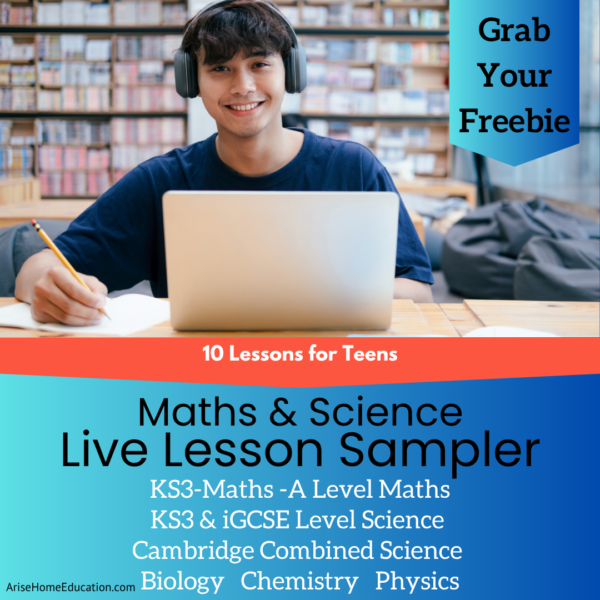
Are Arise Live Classes A Good Fit For Your Teen?
Grab a live lesson bundle and learn about the course, the tutor, and the weekly homework load.











1 thought on “Functional Skills Maths for Home Educated Teens”
Comments are closed.