
Art History for Teens
On Beauty, God, and Comprehensive Learning
This article about Art History curriculum for teens is a collaborative work with Susan Murray. She tutors Art History Year 1 and Year 2 (coming for 2027-28).
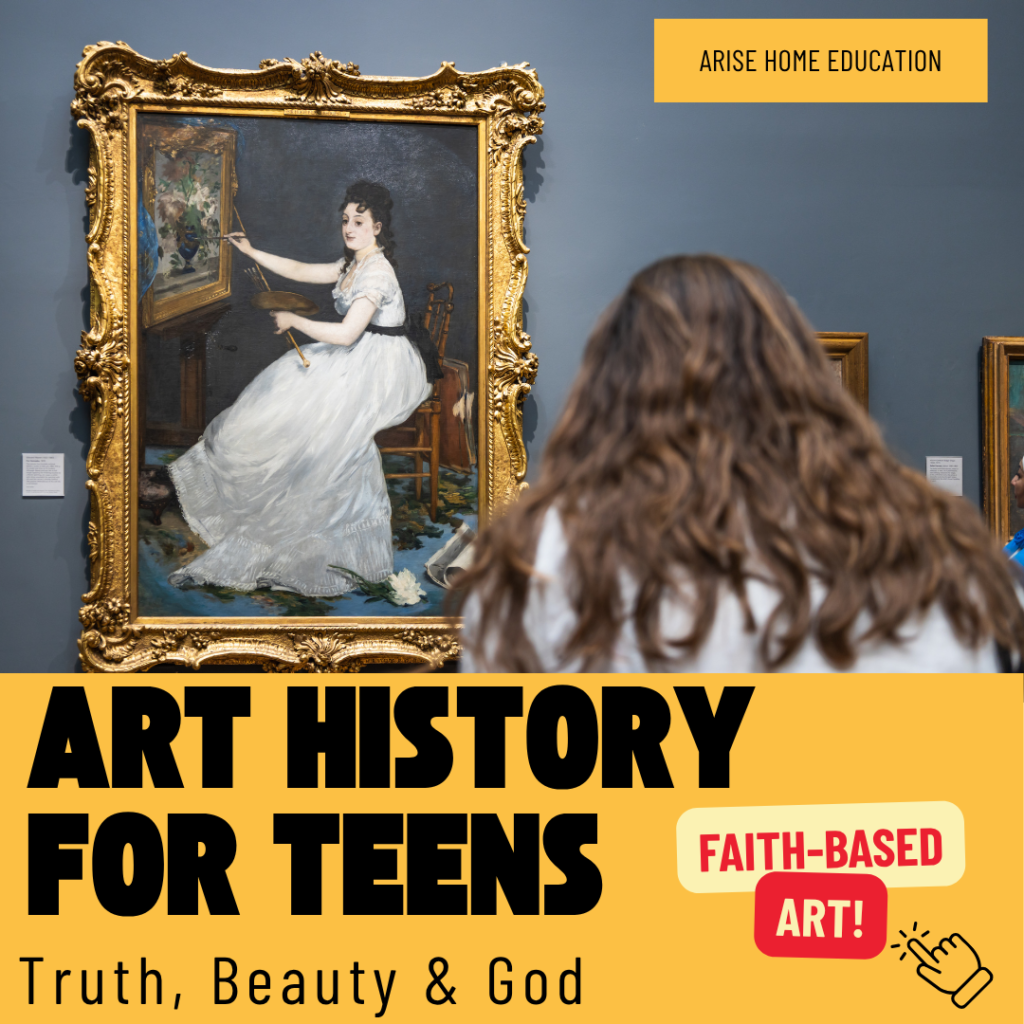
Why do people love beauty?
The great theologian Augustine, lamenting his delayed conversion, equated beauty with God personified: ‘Late have I loved you, O Beauty ever ancient, ever new, late have I loved you!1’ He later expounded upon this love-beauty-God relationship and explained its effect upon the Christian soul: ‘Since love grows within you, so beauty grows. For love is the beauty of the soul.’2 Perhaps this mysterious synthesis is only understood through the biblical revelation that humans are made in the image of God3. No matter how far we have fallen from our intended position, the shadow of the Divine within us compels us to create, to admire, and to desire beauty. Our longing for beauty reflects our innate longing for connection with God.
Because of our natural attraction to beauty, the field of art history appeals to many; art draws our interest and becomes an effective vehicle for deep diving into slices of history. Incorporating aspects of multiple disciplines, art history brings seemingly unrelated, abstract concepts into visual focus, allowing for concrete understanding of distant or difficult ideas. For this reason, art history appeals immensely to visual learners; it also greatly benefits students in their teenage years. As the teenage brain is growing in its ability to process abstract information, a continuing diet of concrete learning helps lay the groundwork for those abstract ideas to take hold. The more abstract the concept, the more a concrete association can facilitate real understanding. Art history’s strong visual focus provides a framework for grasping highly theoretical concepts. Thus, big ideas from history, anthropology, theology, archaeology and literature can begin to make sense for teenagers when brought together under an art history umbrella. Making these connections between subjects opens the door to critical thinking and helps establish a strong academic foundation for teens.
When we approach an Art History Curriculum Teens course through a biblical worldview, fine arts classes become tools for discipleship, discernment, and deeper appreciation of truth and beauty.
The Key to Unlocking Art History Curriculum for Teens
Visual interpretation is the key to opening these doors in art history. From earliest time, art has been used to communicate; for much of human history, it was the primary method of mass communication. Art was the billboard of old, pronouncing anything of societal importance to the world at large. The rich visual legacies of ancient and medieval civilisations testify to this. In the late sixth century, Gregory the Great praised art as literature for the illiterate, serving to teach an uneducated populous about God4. But how can our modern generation ‘read’ historical art? Although our society is far more literate, we lack the understanding of the original viewers; the differences in culture render much of the intended meaning lost. Modern viewers must work harder to read old artworks because we no longer know the language. In the same way that a historical book makes more sense when we learn the background context, we can better comprehend the import of historical art when we consider the political, religious, and social climate in which it was made. This begins with visual interpretation, which starts simply by paying attention to visual clues. Art history students learn to recognise symbols, interpret their meanings, and identify the artistic patterns of various people groups, allowing them to read historical artworks in the way they were intended. Developing these visual interpretation skills enables a greater appreciation of art itself as well as a better insight into the originating civilisations.
Art History Curriculum for Teens with a Christian Worldview
A Christian study of art history both widens the subject and fixes the perspective, adding the element of wisdom to a broad field of knowledge. The widened subject includes not only the general historical disciplines but also church history and worldview analysis; the Christian perspective offers a firmly anchored viewpoint from which to explore various cultures. Believing students can open whole reams of knowledge by engaging deeply with art that is lovely, excellent, and praiseworthy.5 Again quoting Augustine, ‘Thus there is in God…wisdom, by participation in which souls are wise, and beauty, by participation in which all beautiful things are beautiful.’6 In short, a biblically based study of art history immerses students in Beauty and arms them with reasons to believe7 while building a framework of academic knowledge, thereby promoting holistic understanding of a comprehensive subject.
Instilling an Appreciation for Truth and Beauty
From a Christian home education perspective, studying art history is about far more than learning names of artists or memorising dates. It is about helping our teens understand the world God created, the cultures people have built, and the ways human creativity reflects the image of the Creator. When we approach an Art History Curriculum Teens course through a biblical worldview, fine arts classes become tools for discipleship, discernment, and deeper appreciation of truth and beauty.
One of the key reasons art history matters for Christian families is that worldview shapes how we interpret everything we see. A worldview is simply the lens through which we understand the world, and for believers, that lens is grounded in Scripture and God’s design for creation. When children learn history from a biblical worldview, they are taught to see events as part of God’s story rather than random human progress. The same principle applies to art. Understanding when and why a piece of art was created helps students see how beliefs, values, and faith influenced culture throughout history.
This is especially important in the teenage years, when young people are beginning to think more deeply and ask bigger questions. Art often reflects the ideas of its time — sometimes honouring God, sometimes rejecting Him, and sometimes searching for truth without knowing where to find it. Studying art history in a faith-based setting allows teens to explore these ideas safely, with guidance, rather than encountering them without context later on.
Learning about art helps teens see human culture at its best.
Another reason art history is valuable is that creativity itself comes from God. Scripture shows us a Creator who delights in beauty, detail, colour, and design. From the craftsmanship of the Tabernacle to the poetry of the Psalms, the Bible is full of artistic expression. When teens study art history, they begin to see that creativity is not worldly or unnecessary — it is part of being made in God’s image. Learning about art helps them recognise that human culture, at its best, reflects the order, beauty, and purpose God placed in the world.
For many Christian home educating families, however, there is a real concern about what is included in art history courses. Traditional art history often includes nudity, inappropriate themes, or worldviews that do not align with biblical values. This is why it is so important to choose a course with central themes designed specifically for Christian families.
Art History that Honours Truth and Modesty
In our Art History Curriculum for Teens course, the focus is on learning about art in a way that honours both truth and modesty. The course will be using age-appropriate art with a Christian worldview, carefully selected so that families can feel confident about what their children are studying. There will be no nudity in this faith-based class for students 11+, and all material is chosen with the goal of building understanding without compromising family convictions.
This approach allows teens to gain a broad knowledge of art history while still protecting innocence and encouraging discernment. Rather than avoiding the subject altogether, students learn how to think biblically about culture. This type of critical thinking is an essential skill to be practiced as students prepare for adulthood.
Introductory Art Classes at Arise
-

Art History Year 1
£398.00 -

Intro to Art: Art Studio Year 1
£396.00
Online Art Classes at Arise
Online courses such as the one offered through the Arise Home Education arts programme are designed with this balance in mind, helping students explore artistic styles, historical periods, and cultural influences in a way that is engaging, structured, and appropriate for their stage of development. These kinds of courses aim to build confidence, curiosity, and a love of learning while supporting families who want education to reflect their faith. By including the study of ancient art, medieval art, contemporary art, and famous artists from the world’s greatest art museums, we create a solid foundation that supports literature, history, and apologetics studies in future years. Particular emphasis on the historical context of works of art and their creators offers excellent opportunities for the visual arts to be used to better understand cultural contexts.
For the Christian homeschool mom teaching art history curriculum for teens at home, art history can sometimes feel like an extra subject that is easy to leave out. But in reality, it plays an important role in helping teens understand the world they live in. Through art history, teens learn to recognise beauty, think critically, and see how beliefs shape culture; all while being reminded that God is the ultimate source of creativity.
When taught from a Christian worldview, art history is not just about paintings.
It is about helping our young people see the world through the light of truth.
Art History Curriculum for Teens at Arise
The Art History program at Arise is a 2-year course for students as young as 11 years old. It helps lay the foundation for upper secondary classes in art, apologetics, literature, and more. By studying art history, kids will grow in their understanding of the importance of art by using artist and museum studies, field trips to their local museums, and creative projects.

______________
- St. Augustine, c. 397 A.D., Confessions. ↩︎
- St. Augustine, c. 414 A.D., Ten Homilies on the First Epistle of John. ↩︎
- Genesis 1:26-27, The Holy Bible. ↩︎
- Gregory the Great, 599 A.D., Letter to Bishop Serenus of Marseilles. ↩︎
- Philippians 4:8, The Holy Bible. ↩︎
- St. Augustine, 415 A.D., On Genesis. ↩︎
- 1 Peter 3:15, The Holy Bible. ↩︎
1 thought on “Art History Curriculum for Teens”
Comments are closed.