
You want your young teens to master shading and composition. You also want them grounded in truth. Here’s how to get both in one foundational course. Art lessons for teens without the worldview compromise are achievable. Here’s how.
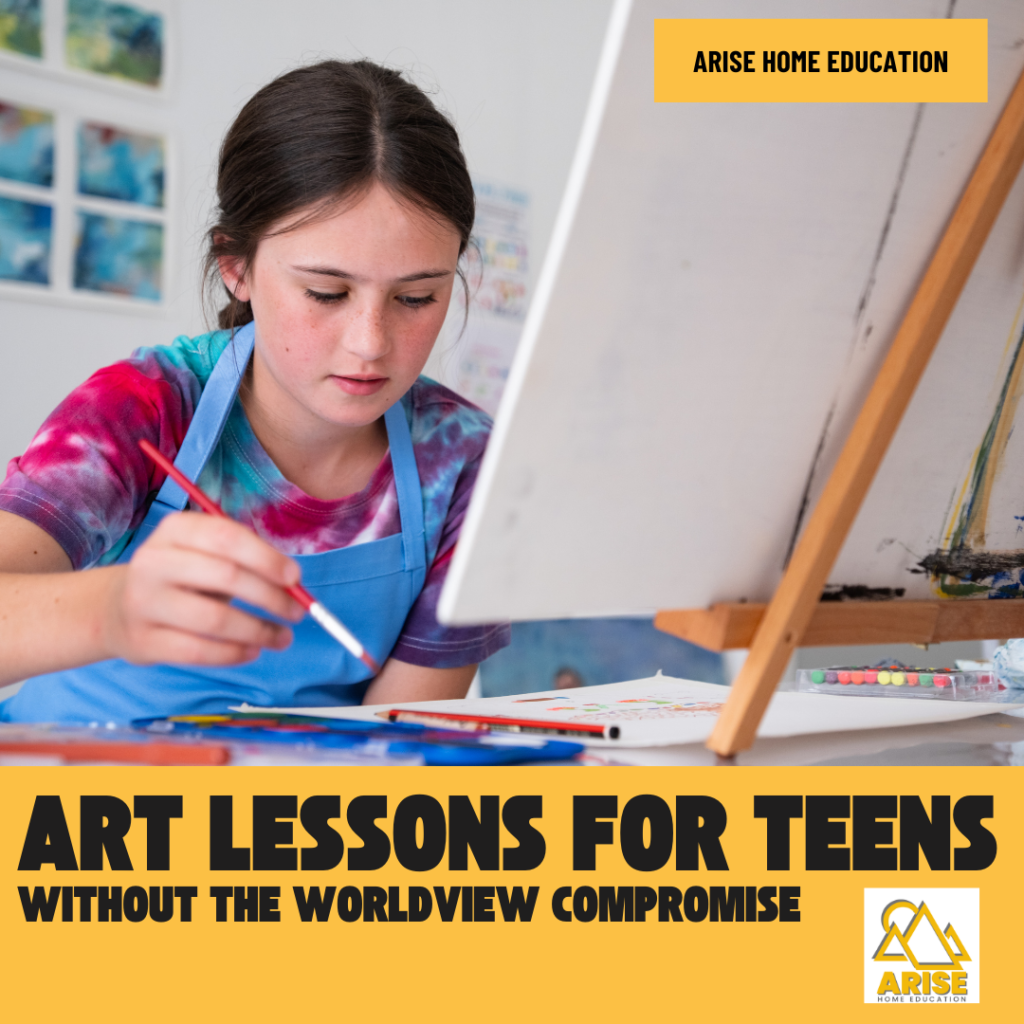
Art Lessons for Teens With a Christian Worldview
Have you noticed your teenager sketching in the margins of their math notebook again?
Before you dismiss it as distraction, you might want to consider what’s actually happening there. Those margins are where spatial reasoning meets hand-eye coordination. Where observation sharpens. Where the brain learns to translate three-dimensional reality onto a two-dimensional surface. That’s not filler activity—that’s foundational cognitive development happening in real time, and it doesn’t stop being valuable just because it’s happening during algebra.
Art education for teens isn’t really about producing museum-ready portfolios or discovering the next Rembrandt. It’s more about equipping young artists and minds with visual literacy, technical skills, and creative problem-solving abilities that will serve them whether they become architects, engineers, writers, or stay-at-home parents. The question isn’t whether your teen has “natural talent.” The question is whether you’re going to give them the structured training to develop the observational and technical skills they’ll use for the rest of their lives.
Here’s what can shift when you introduce intentional art instruction between ages 11 and 14, and why a Christian worldview might make all the difference in how they see their own creativity.
What Foundational Art Lessons for Teens Actually Look Like
You might think art education for teens means finger painting evolved into watercolors. It’s actually quite different.
Between ages 11 and 14, students are developmentally ready to move past symbol-based drawing and into true observational work. This is a golden window where their brains can handle perspective, proportion, value scales, and compositional balance. Wait too long, and you’re teaching remedial skill levels to high school students. Start now, and you’re building on their natural curiosity while their neural pathways are still highly adaptable.
Core technical skills include:
- Line quality and control – Learning to vary pressure, direction, and weight to create dimension and interest rather than flat outlines
- Value and shading techniques – Understanding how light behaves on form using hatching, cross-hatching, blending, and stippling
- Perspective basics – One-point and two-point perspective that make drawings look three-dimensional instead of floating in space
- Proportion and measurement – Training the eye to see relationships between objects, not just copy what the brain thinks it knows
- Composition fundamentals – Rule of thirds, focal points, visual hierarchy, and how to guide a viewer’s eye across the page
- Color theory foundations – Hue, value, saturation, complementary relationships, and how colors interact to create mood
These aren’t just artsy buzzwords. They’re the same principles used in graphic design, architecture, product development, and digital media. A teen who understands how light falls on a sphere can troubleshoot a 3D rendering. A middle school or high school student who grasps one-point perspective can visualize engineering drawings. Art skills aren’t isolated to canvas and clay—they cross-pollinate into every subject that requires spatial thinking and visual communication.
Programs like the Intro to Art Studio Year 1 course from Arise Home Education build these exact competencies through structured lessons designed specifically for the 11-14 age range, moving students from beginner hesitation to confident execution over the course of a school year. Online art classes like this one offer focused class time to explore everything from pencil techniques to oil pastels. New concepts in the art lessons provide an opportunity for first-time art class students to improve fine motor skills and explore different art styles and compositions. Landscape drawing, portrature and linear perspective will be introduced in an enjoyable manner for first-time art class participants.
How Art Training Strengthens Other Academic Subjects
Here’s something most homeschool families don’t realize at first: art isn’t really a break from “real” academics.
Art education actually improves performance in math, science, and language arts because it trains the brain to observe, analyze, and problem-solve in ways that textbook drills can’t quite replicate. When a student learns to draw a still life, they’re practicing the same skills required to interpret data charts, visualize geometry proofs, and mentally rotate objects in physics problems.
Observational drawing builds scientific thinking. Biology students who can sketch what they see under a microscope tend to retain more information than students who only read descriptions. The reason is that drawing forces the brain to slow down and truly observe details, textures, and relationships. It’s active learning, not passive absorption.
Perspective and proportion sharpen math skills. Understanding how objects shrink as they recede into space is applied geometry. Measuring proportions by sight teaches estimation and ratio work. When teens learn to divide a canvas into thirds or calculate vanishing points, they’re doing spatial math without even realizing it.
Composition strengthens writing and communication. A well-composed drawing leads the viewer’s eye just like a well-structured paragraph leads the reader’s attention. Learning to create visual hierarchy on paper translates directly to organizing ideas in essays. Both require clarity, emphasis, and intentional flow.
Color theory develops analytical thinking. Mixing colors to achieve a specific result is hypothesis testing. If I add more blue, what happens? If I layer yellow over red, does it create the orange I need? That’s experimentation, observation, and adjustment—the scientific method applied to a palette.
Art doesn’t compete with core academics. It reinforces them through a different entry point, giving kinesthetic and visual learners another way to access the same cognitive skills.
Art Classes at Arise
-
Art History Year 1
Original price was: £398.00.£198.00Current price is: £198.00. -

Bronze Level UK Arts Award
£80.08 -

DSLR Photography Year 1
£396.00 -

DSLR Photography Year 2 for Silver Art Award
£203.50 -
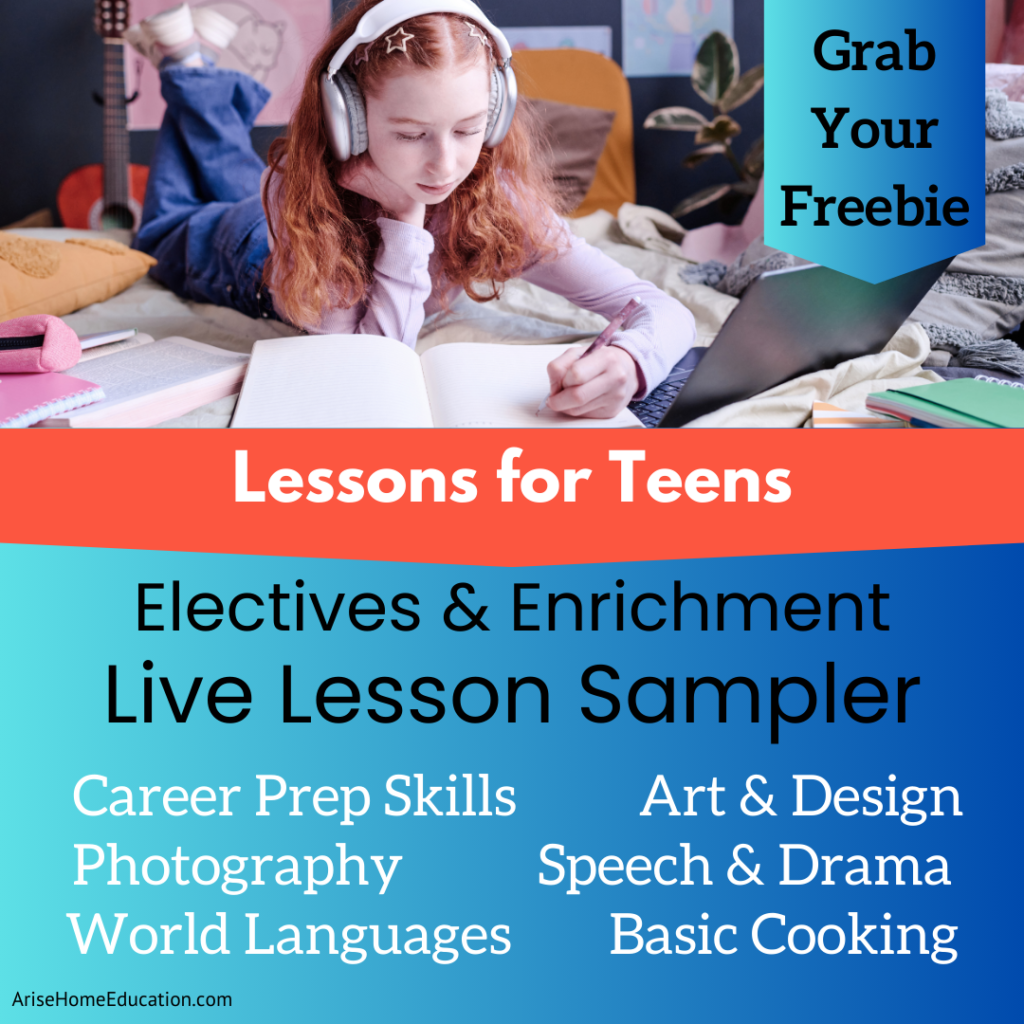
Electives and Enrichment Live Lesson Sample Bundle
£0.00 -
Explore Arts Award
Original price was: £80.08.£72.80Current price is: £72.80. -

High School Art and Design Year 1
£396.00 -

High School Art and Design Year 2
£396.00 -

Intro to Art: Art Studio Year 1
£396.00


Why the Christian Worldview Component Matters in Art Education
When you strip the worldview out of art instruction, you’re left with technique without meaning.
Secular art programs teach students how to draw, but they rarely address why humans create in the first place or what that impulse reveals about our nature. A Christian approach to art education roots creativity in theology: we create because we are made in the image of a Creator. Art isn’t self-expression for its own sake. It’s stewardship of a gift meant to reflect truth, beauty, and order back to the One who invented all three.
Students learn they are sub-creators, not autonomous artists. This reframes the entire purpose of making art. Instead of “I create to express myself,” it becomes “I create to reflect the character of God and serve others through beauty and skill.” That shift about their own style changes how students approach their work, critique their own efforts, and respond to feedback.
Beauty and order point to a Designer. When teens study perspective, proportion, and color harmony, they’re observing the mathematical and structural principles woven into creation itself. A Christian worldview helps them see that these principles aren’t arbitrary human inventions. They’re reflections of God’s nature embedded in the way light works, the way the human eye perceives contrast, and the way composition creates visual rest or tension.
Art can be used for good or twisted for harm. Not every artistic choice is morally neutral. Teaching teens to evaluate art through a biblical lens equips them to discern what messages are being communicated through imagery, style, and content. They learn to ask: Does this image promote truth? Does it honor human dignity? Does it glorify God or distort His design?
Programs that integrate a Christian worldview don’t just tack on a Bible verse at the end of a lesson. They build the entire instructional framework around the understanding that creativity is a sacred responsibility, not just a secular skill set.
Explore all that Arise Home Education offers families looking for art lessons for their teens.

The Arts
Arise Home Education Arts for ages 11-17.













1 thought on “Art Lessons for Teens Without Worldview Compromise”
Comments are closed.