Teaching Honest Research and Writing in the Age of AI
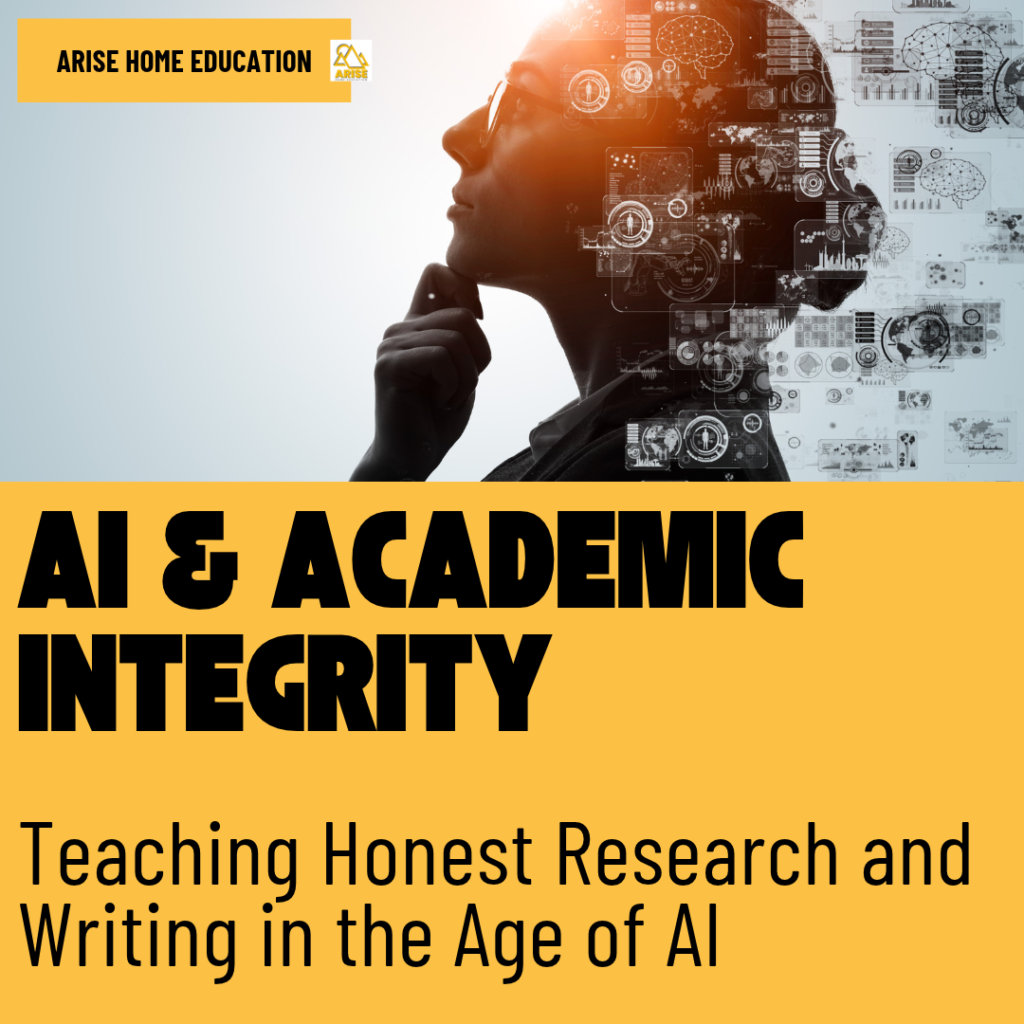
In an age where artificial intelligence (AI) is becoming increasingly integrated into our daily lives, the question of how to write with integrity has never been more important, especially for Christian families educating their children at home. Understanding AI and Academic Integrity needs to start early for Christian home educating families.
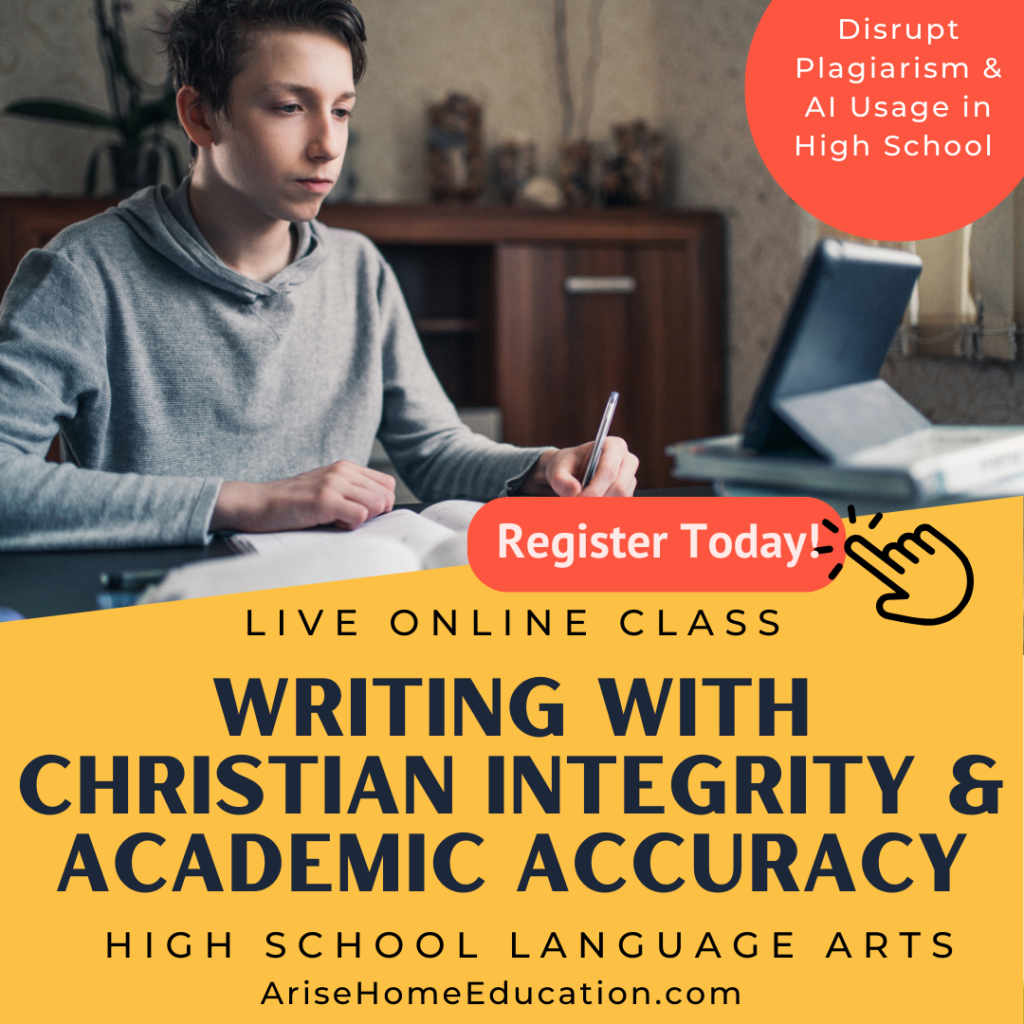
At Arise, we are introducing a new course called Writing with Christian Integrity and Academic Accuracy, designed to equip students with the skills they need to navigate the complex landscape of research, citation, and ethical writing in the digital age.
Why Understanding AI and Academic Integrity Matters Now
Everywhere we turn, there is easy access to other people’s material or computer-generated content. As home educators, we have a responsibility to teach our children not only how to write well, but also how to write properly, giving honour and credit where credit is due.
This goes beyond just avoiding plagiarism. It is about understanding that just as we would not use bootlegged albums, movies, or books without paying royalties, we should not take other people’s ideas and call them our own.
The AI Complication
One of the most challenging aspects of modern writing is the rise of AI tools like ChatGPT. When a student asks an AI for help with homework or essay writing, that AI generates information harvested from countless sources across the web. Even in its most innocent form, just trying to get the creative juices flowing, it is very easy to slip into plagiarism without even realizing it.
It can be so difficult for young students especially, to understand what they are actually accessing when it comes to online research. Understanding how AI works and when is the proper time ( if ever) to use it in academics, provide students of all ages an opportunity to learn how to approach understanding AI and academic integrity whilst being guided by parents and tutors.
Unlike copying directly from a textbook or website, which is easily recognizable as plagiarism, AI-assisted plagiarism is subtle. Students using AI to help with their work may not even recognize they are plagiarizing until they are pulled up for it at university, and by then, the consequences sting.
So… How do you cite AI with integrity and academic accuracy?
Here is an interesting question: How do you cite AI? Most of us probably do not know. The problem is that you cannot really cite AI the way you cite traditional sources. If you ask the same question on a different day, or to a different AI platform, Gemini versus ChatGPT versus Claude, you will get different answers. As mentioned in the podcast, it can sometimes be like trying to cite an unrecorded conversation.
For academic settings where AI use is permitted, until recently, researchers literally have to list every question asked, all prompts given, and what answers were received, pulling it all into a cited reference document. When you look at all those hoops, you realize it is often not worth it. You could have spent 25 minutes reading the actual text and gotten better results.
Now, there are more concrete guidelines to follow, but research style guides ( MLA, Harvard, Chicago), very widely is what is expected to be included.
Creating a Family Honour Code about AI and Academic Integrity
What makes the Writing with Christian Integrity and Academic Accuracy course unique is that the first two weeks are spent with students working alongside their families to create a family honour code along with an AI and plagiarism policy.
We recognize that every family has a different line when it comes to AI. This course is not about dictating the right way to use AI. It is about helping your family think through your own worldview on artificial intelligence and create a family culture around it.
Even within Arise, we have different perspectives on AI. Some have never logged onto ChatGPT and have no intention of using it. Others find valid and helpful uses, perhaps to make technical terminology more accessible for a student with learning differences, or to better understand complex instructions.
This diversity of perspective actually provides a healthy balance. There are places where AI could be seen as plagiarism, and places where it is truly a helpful tool. The difference comes when you take it too far, when you claim AI-generated work as your own original creation and put your name to it. That is plagiarism.
Writing for Teens
-
Writing with Christian Integrity & Academic Accuracy
Original price was: £203.50.£198.00Current price is: £198.00.
What Students Will Learn about AI and Academic Integrity
This single-semester course is designed for students aged 12-15, Key Stage 3 and above, including those who have taken other English or writing classes. Here is what the course covers:
Weeks 1-2: Creating a family honour code and AI and plagiarism policy
Weeks 3-5: Disrupting plagiarism, learning to identify the 10 different ways to plagiarize. Yes, there are 10 distinct types.
Weeks 6-7: Planning and research. Students choose a topic of interest to them, learn how to research properly using actual sources, books, magazines, reputable websites, not AI,
Weeks 8-12: Resource citation and note taking. Learn to cite sources, take effective notes, and write from those notes rather than copying source material.
Week 13-15: Turn rough drafts into final drafts. Presenting their reports and defending your work. Students present their papers and answer questions about their research and conclusions.
Students will write only one paper during the course, either five paragraphs for younger students or seven or more paragraphs, 1,000 plus words, for older students. But the emphasis is on quality, proper citation, and truly understanding your subject matter.
How Defence Works to Produce Academic Integrity in the Age of AI
The defence component, where students present their work and answer questions, is increasingly how universities are AI-proofing their courses. This is valuable preparation regardless of whether your student is heading toward high education language arts, humanities, sciences, or any other field.
When a student truly knows their subject, they can speak to it confidently. When they are waffling, it reveals they have not internalized the material enough, either because they did not put in the effort or because they used AI or plagiarism and cannot actually speak to the content.
This idea of defending your work has traditionally been reserved for Masters or PhD dissertations. At Arise, we are taking that same concept and simplifying it for younger students, not to create stress, but to build the skill early and produce confident writers and speakers.
Building Critical Thinkers Who Understand AI and Academic Integrity
What do we want for future generations? We want children who can think critically from a faith-filled perspective, who know how to conduct research, who can identify truth and filter out what is not true.
This course provides the building blocks for those skills. When students move into higher-level classes, whether logic, apologetics, literature analysis, sciences, or history, they will already have these foundational skills working for them. They will be ready to exercise their writing skill and confidence in how to do good research no matter to course.
Teaching our children to write with integrity and academic accuracy from a young age means these principles will go with them into their future, prepared not just for university, but for a lifetime of honest scholarship and clear thinking.
Part of this approach includes providing access to quality resources that are not AI-generated. Yes, going old school with actual books and magazines, while still utilizing the internet for research from real, citable sources.
The Christian Integrity Component
The Christian integrity aspect of this course goes beyond just avoiding plagiarism. It is about learning to cite properly and honour truth in whatever subject you are working on.
Think about how we memorize Scripture. We do not just memorize the words, but also the reference: the book, chapter, and verse. That is actually a type of citation. We are teaching that same principle of giving credit and maintaining accuracy across all types of writing and research.
Writing with Academic Integrity for Teens
-
Writing with Christian Integrity & Academic Accuracy
Original price was: £203.50.£198.00Current price is: £198.00.
Is This Course Right for Your Home Ed. Student?
This course is best suited for students aged 12-15 who can already write one to three paragraphs. If your student has taken our Key Stage 3 Year One class, they are in exactly the right place for this.
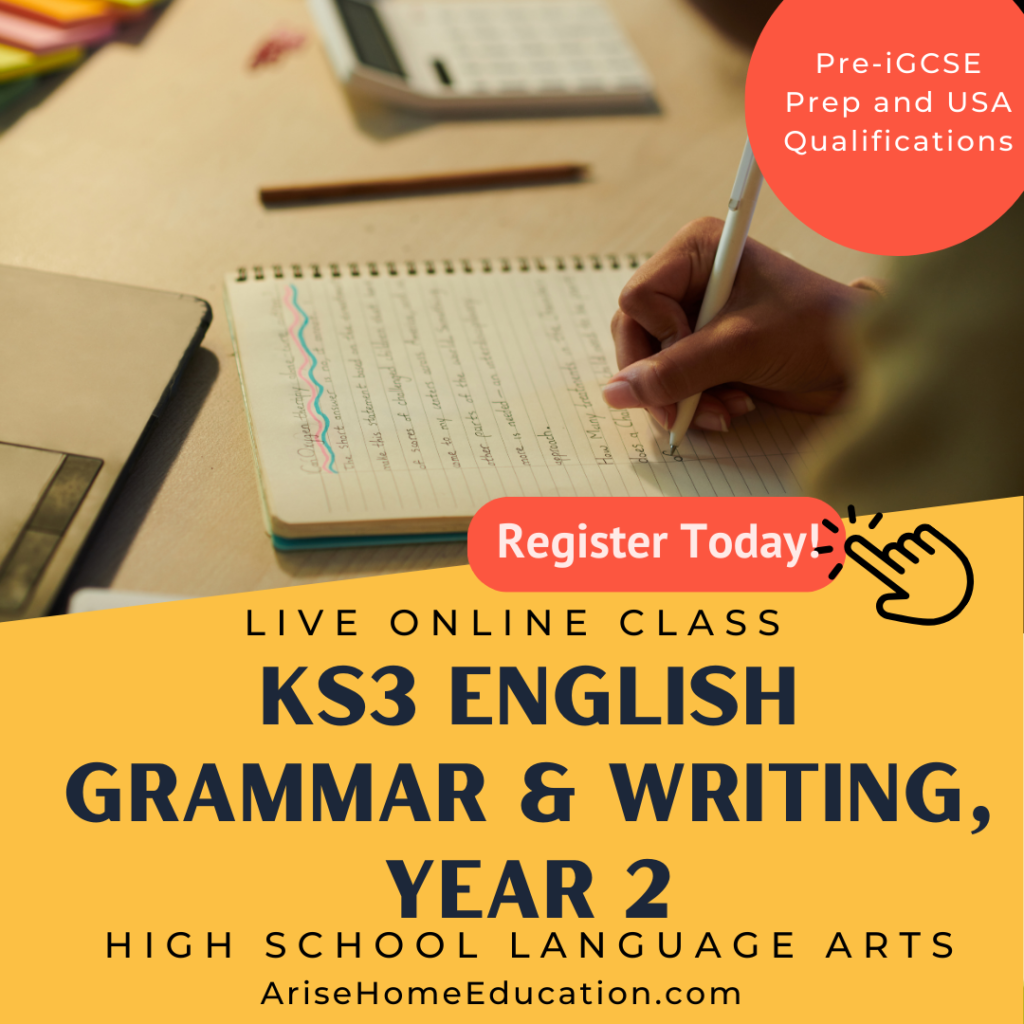
In fact, this course is the first semester of our Key Stage 3 Year Two Grammar and Writing class. If you are signing up for that year-long course, this content is already included. You do not need to sign up separately.
For students who are already beyond that level in writing, or for those who need course correction in how to write with honour and integrity, they are absolutely welcome. We will scale expectations appropriately. Younger students will write shorter papers while older students will be expected to write longer reports.
This single semester course will be offered both in September and again in January; giving families flexibility in when to start.
A Course for The Times We Live In
This is not just another writing class. It is a response to the unique challenges our children face in an age of readily available AI, where the lines between original work and plagiarism have become blurred.
By teaching our students early, before these habits become ingrained, we are preparing them to be writers, thinkers, and researchers who can stand confidently on work that is truly their own, properly researched, and honestly cited.
In a world where it is easier than ever to cut corners, we are equipping the next generation to choose the harder path: the path of integrity, accuracy, and truth.
If you have questions about this course or would like more information, please email us at arise@arisehomeeducation.com. We are here to support your family in raising students who write with both Christian integrity and academic excellence.
English Grammar & Writing Classes at Arise
-
Writing with Christian Integrity & Academic Accuracy
Original price was: £203.50.£198.00Current price is: £198.00. -
KS3 English Grammar & Writing Year 2
£396.00 -

KS3 English Grammar & Writing, Year 1
£396.00 -

IGCSE English First Language
£396.00
Are Arise Live Classes A Good Fit For Your Teen?
Grab a live lesson bundle and learn about the course, the tutor, and the weekly homework load.

















1 thought on “How Christian Home Educators Can Navigate AI and Academic Integrity”
Comments are closed.